

How To Set Up A Propel Trampoline

Gymnastics is a sport that includes physical exercises requiring balance, strength, flexibility, agility, coordination, dedication and endurance. The movements involved in gymnastics contribute to the development of the arms, legs, shoulders, dorsum, chest, and abdominal musculus groups. Gymnastics evolved from exercises used by the ancient Greeks that included skills for mounting and dismounting a horse, and from circus performance skills.
The virtually common class of competitive gymnastics is artistic gymnastics (AG), which consists of, for women (WAG), the events floor, vault, uneven bars, and beam; and for men (Magazine), the events floor, vault, rings, pommel horse, parallel confined, and horizontal bar. The governing body for gymnastics throughout the world is the Fédération Internationale de Gymnastique (FIG). Eight sports are governed by the FIG, which include Gymnastics for All, Men's and Women's Creative Gymnastics, Rhythmic Gymnastics, Trampoline (including Double Mini-trampoline), Tumbling, Acrobatic, Aerobic and Parkour.[1] Disciplines non currently recognized by FIG include Wheel gymnastics, Aesthetic group gymnastics, TeamGym, and Mallakhamba.
Participants in gymnastics-related sports can include young children, recreational-level athletes, and competitive athletes at varying levels of skill, including world-grade athletes.
Etymology [edit]
The word gymnastics derives from the common Greek describing word γυμνός ( gymnos ),[2] by way of the related verb γυμνάζω (gymnazo), whose significant is to "railroad train naked", "railroad train in gymnastic exercise", by and large "to train, to exercise".[three] The verb had this meaning considering athletes in ancient times exercised and competed without clothing.
History [edit]

Gymnastics can be traced to exercise in ancient Greece- in Sparta and Athens. That exercise for that time was documented past Philostratus'[4] work Gymnastics. Practice in the gymnasium in later on periods prepared men for state of war. The original term for the practice of gymnastics is from the related Greek verb γυμνάζω (gumnázō), which translates every bit "to train naked or nude" considering immature men exercising trained without clothing. In ancient Greece, physical fitness was a highly valued attribute in both men and women. Information technology wasn't until after the Romans conquered Greece in 146BC that gymnastics became more formalized and used to train men in warfare.[5] Based on Philostratus' claim that gymnastics is a form of wisdom, comparable to philosophy, poetry, music, geometry, and astronomy,[4] Athens combined this more than concrete training with the pedagogy of the mind. At the Palestra, a concrete education grooming center, the bailiwick of educating the torso and educating the mind were combined allowing for a form of gymnastics that was more artful and individual and which left behind the form that focused on strictness, subject field, the emphasis on defeating records, and focus on force.[6]
Don Francisco Amorós y Ondeano, was born on Feb 19, 1770, in Valencia and died on August 8, 1848, in Paris. He was a Spanish colonel, and the first person to introduce educative gymnastics in France. The High german Friedrich Ludwig Jahn started the German gymnastics movement in 1811 which led to the invention of the parallel confined, rings, high bar, the pommel horse and the vault equus caballus.
Germans Charles Beck and Charles Follen and American John Neal brought the first wave of gymnastics to the Us in the 1820s. Brook opened the start gymnasium in the Usa in 1825 at the Round Colina School in Northampton, Massachusetts.[seven] Follen opened the first college gymnasium and the outset public gymnasium in the Usa in 1826 at Harvard College and in Boston, Massachusetts, respectively.[viii] Neal was the kickoff American to open up a public gymnasium in the U.s. in Portland, Maine in 1827.[9] He also documented and promoted these early efforts in the American Journal of Education [10] and The Yankee, helping to institute the American co-operative of the movement.[11]

Early on 20th-century gymnastics in Stockholm, Sweden
The Federation of International Gymnastics (FIG) was founded in Liege in 1881.[12] Past the finish of the nineteenth century, men's gymnastics competition was popular plenty to be included in the beginning modernistic Olympic Games in 1896. From and so on until the early 1950s, both national and international competitions involved a changing variety of exercises gathered under the rubric, gymnastics, that included, for example, synchronized team flooring calisthenics, rope climbing, high jumping, running, and horizontal ladder. During the 1920s, women organized and participated in gymnastics events. The get-go women'south Olympic competition was limited, merely involving synchronized calisthenics and runway and field. These games were held in 1928, in Amsterdam. By 1954, Olympic Games apparatus and events for both men and women had been standardized in modern format, and compatible grading structures (including a signal system from one to 15) had been agreed upon. At this time, Soviet gymnasts astounded the world with highly disciplined and difficult performances, setting a precedent that continues. Television has helped publicize and initiate a modern age of gymnastics. Both men's and women's gymnastics now attract considerable international involvement, and excellent gymnasts tin be found on every continent.
In 2006, a new points system for Artistic gymnastics was put into play. With an A Score (or D score) being the difficulty score, which as of 2009 is based on the top 8 high scoring elements in a routine (excluding Vault). The B Score (or Due east Score), is the score for execution and is given for how well the skills are performed.[xiii]
FIG-recognized disciplines [edit]
The following disciplines are governed by FIG.
Artistic gymnastics [edit]
Artistic Gymnastics is usually divided into Men's and Women's Gymnastics. Men compete on six events: Flooring Practice, Pommel Horse, Notwithstanding Rings, Vault, Parallel Bars, and Horizontal Bar, while women compete on four: Vault, Uneven Bars, Balance Beam, and Floor Exercise. In some countries, women at once competed on the rings, high bar, and parallel confined (for example, in the 1950s in the USSR).
In 2006, FIG introduced a new point system for Artistic gymnastics in which scores are no longer express to 10 points. The system is used in the U.s.a. for elite level competition.[13] Dissimilar the old lawmaking of points, there are ii carve up scores, an execution score and a difficulty score. In the previous system, the execution score was the only score. Information technology was and still is out of 10.00, except for curt exercises. During the gymnast'south performance, the judges deduct this score only. A autumn, on or off the event, is a i.00 deduction, in elite level gymnastics. The introduction of the difficulty score is a pregnant change. The gymnast'south difficulty score is based on what elements they perform and is subject to change if they do non perform or consummate all the skills, or they practice not connect a skill meant to exist connected to some other. Connection bonuses are where difference happens most mutual betwixt the intended and actual difficulty scores, as it can exist difficult to connect multiple flying elements. Information technology is very difficult to connect skills if the first skill is not performed correctly. The new code of points allows the gymnasts to gain college scores based on the difficulty of the skills they perform too as their execution. At that place is no maximum score for difficulty, as it can keep increasing every bit the difficulty of the skills increment.
Competitive events for women in artistic gymnastics [edit]
Vault [edit]
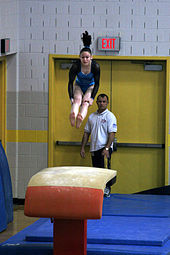
In the vaulting events, gymnasts dart down a 25 metres (82 ft) runway, to take off onto a vault board (or perform a roundoff or handspring entry onto a vault board), to state momentarily inverted on the hands on the vaulting horse or vaulting table (pre-flight segment), and so propel themselves frontward or backward off that platform to a two-footed landing (post-flight segment). Every gymnast starts at a unlike point on the vault runway depending on their height and strength. The mail service-flight segment may include 1 or more than multiple saltos, or twisting movements. A circular-off entry vault, called a Yurchenko, is a commonly performed vault in the higher levels in gymnastics. When performing a Yurchenko, gymnasts round-off so their hands are on the track while their feet state on the vault lath. From the round-off position, the gymnast travels backward and then that the hands land on the vaulting table. The gymnast and then blocks off the vaulting platform into various twisting and/or somersaulting combinations. The mail-flying segment brings the gymnast to her anxiety. Less difficult vaults include taking off from the vault board with both anxiety at the same time and either doing a front end handspring or circular-off onto the vaulting tabular array.
In 2001, the traditional vaulting horse was replaced with a new appliance, sometimes known as a tongue, equus caballus, or vaulting table. The new apparatus is more than stable, wider, and longer than the older vaulting horse, approximately i yard in length and ane m in width, giving gymnasts a larger blocking surface. This apparatus is thus considered safer than the vaulting equus caballus used in the by. With the addition of this new, safer vaulting table, gymnasts are attempting more difficult vaults.[fourteen]

Uneven bars [edit]
On the uneven bars, the gymnast performs a timed routine on two parallel horizontal bars gear up at different heights. These bars are made of fiberglass covered in wood laminate, to prevent them from breaking. In the past, bars were made of wood, but the bars were prone to breaking, providing an incentive to switch to newer technologies. The width and superlative of the confined may be adapted to the size needed by private gymnasts. In the past, the uneven parallel bars were closer together. The bars have been moved increasingly farther autonomously, allowing gymnasts to perform swinging, circling, transitional, and release moves that may pass over, nether, and between the 2 bars. At the Elite level, movements must pass through the handstand. Gymnasts often mount the uneven bars using a springboard or a small mat. Gymnasts may employ chalk (MgCO3) and grips (a leather strip with holes for fingers to protect hands and improve functioning) when performing this event. The chalk helps take the moisture out of gymnasts' easily to decrease friction and preclude rips (tears to the skin of the hands); dowel grips aid gymnasts grip the bar.
Rest beam [edit]

Dorina Böczögő performing a one-arm press hold during her residuum beam mount, 2022
The gymnast performs a choreographed routine of up to ninety seconds in length consisting of leaps, acrobatic skills, somersaults, turns and dance elements on a padded beam. The axle is 125 centimetres (four ft 1 in) from the ground, five metres (16 ft 5 in) long, and 10.16 centimetres (4.00 in) wide.[xv] This stationary object tin can also be adapted, to be raised higher or lower. The event requires balance, flexibility, grace, poise, and strength.
Floor [edit]

Gymnast doing a stag spring on flooring exercise
The upshot in gymnastics performed on the floor is called floor exercise. The English abbreviation for the event in gymnastics scoring is FX. In the past, the flooring exercise event was executed on the bare floor or mats such every bit wrestling mats. The flooring event now occurs on a carpeted 12m × 12m square, usually consisting of difficult foam over a layer of plywood, which is supported by springs by and large called a spring floor. This provides a firm surface that provides extra bounce or spring when compressed, assuasive gymnasts to achieve greater height and a softer landing afterward the composed skill. Gymnasts perform a choreographed routine for up to xc seconds in the floor do result. Depending on the level, the gymnast may cull their own routine; however some levels have compulsory routines, where default music must be played. Levels 3 to half dozen the music is the same for each levels along with the skills inside the routine. However, recently, the levels have switched. Now, levels 6–ten are optional levels and they become to accept custom routines fabricated. In the optional levels (levels half-dozen to ten) there are skill requirements for the routine but the athlete is able to pick her own music without whatever words. The routine should consist of tumbling passes, serial of jumps, leaps, trip the light fantastic elements, acrobatic skills, and turns, or pivots, on one foot. A gymnast can perform upward to four tumbling passes, each of which usually includes at least one flight element without hand support. Each level of gymnastics requires the athlete to perform a dissimilar number of tumbling passes. In level 7 in the United States, a gymnast is required to do 2–3, and in levels 8–10, at to the lowest degree 3–4 tumbling passes are required.[16]
Scoring [edit]
Scoring for both Inferior Olympic and NCAA level gymnastics uses a 10.0 calibration. Levels below Level nine start from a ten.0 automatically if all requirements for an event are met. Levels 9 and ten, and NCAA gymnastics all start below a 10.0 and require gymnastics to acquire bonus points through connections and skills to increase their start value to a 10.0. During a routine, deductions volition be made by the judges for flaws in the form of the technique of a skill. For example, steps on landings or flexed feet can range from .05-.i off, depending on the severity of the mistake.[17]
Competitive events for men in creative gymnastics [edit]
Floor [edit]
Male gymnasts also perform on a 12meter x 12meter spring floor. A serial of tumbling passes are performed to demonstrate flexibility, forcefulness, and balance. Strength skills include circles, scales, and press handstands. Men's floor routines usually have multiple passes that take to total between sixty–lxx seconds and are performed without music, unlike the women'southward outcome. Rules crave that male gymnasts touch each corner of the floor at least once during their routine.

Pommel equus caballus [edit]
A typical pommel horse exercise involves both single leg and double leg work. Single leg skills are generally found in the form of scissors, an element often done on the pommels. Double leg work, withal, is the main staple of this event. The gymnast swings both legs in a circular motion (clockwise or counterclockwise depending on preference) and performs such skills on all parts of the appliance. To make the do more than challenging, gymnasts will oft include variations on a typical circumvoluted skill by turning (moores and spindles) or by straddling their legs (Flares). Routines end when the gymnast performs a dismount, either by swinging his body over the equus caballus or landing after a handstand variation.
Still rings [edit]
The rings are suspended on wire cable from a point 5.75 meters from the floor. The gymnasts must perform a routine demonstrating balance, forcefulness, ability, and dynamic motion while preventing the rings themselves from swinging. At least one static strength move is required, merely some gymnasts may include two or three. A routine ends with a dismount.
Vault [edit]
Gymnasts sprint down a runway, which is a maximum of 25 meters in length, before hurdling onto a springboard. The gymnast is allowed to choose where they outset on the runway. The trunk position is maintained while punching (blocking using only a shoulder motility) the vaulting platform. The gymnast then rotates to a standing position. In avant-garde gymnastics, multiple twists and somersaults may exist added earlier landing. Successful vaults depend on the speed of the run, the length of the hurdle, the ability the gymnast generates from the legs and shoulder girdle, the kinesthetic awareness in the air, how well they stuck the landing, and the speed of rotation in the instance of more than hard and circuitous vaults.
Parallel bars [edit]
Men perform on 2 confined executing a series of swings, balances, and releases that require great force and coordination. The width between the confined is adjustable depending upon the actual needs of the gymnasts and usually 2m high.
High bar [edit]
A 2.8 cm thick steel or fiberglass bar raised 2.5 m above the landing area is all the gymnast has to concord onto as he performs giant swings or giants (forward or backward revolutions around the bar in the handstand position), release skills, twists, and changes of direction. Past using all of the momentum from giants then releasing at the proper indicate, enough height tin be achieved for spectacular dismounts, such as a triple-back salto. Leather grips are commonly used to assistance maintain a grip on the bar, and to prevent rips. For grooming this upshot, straps are often used to ensure that you dont fall off the bar when learning new skills.
As with women, male gymnasts are likewise judged on all of their events including their execution, degree of difficulty, and overall presentation skills.
Rhythmic gymnastics [edit]
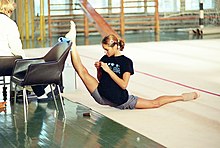
According to FIG rules, only women compete in rhythmic gymnastics. This is a sport that combines elements of ballet, gymnastics, trip the light fantastic toe, and apparatus manipulation. The sport involves the functioning of v separate routines with the use of five apparatus; ball, ribbon, hoop, clubs, rope—on a flooring area, with a much greater emphasis on the aesthetic rather than the acrobatic. There are also group routines consisting of 5 gymnasts and 5 apparatuses of their choice. Rhythmic routines are scored out of a possible 30 points; the score for artistry (choreography and music) is averaged with the score for the difficulty of the moves and and then added to the score for execution.[18]
International competitions are split between Juniors, nether xvi by their year of birth; and Seniors, for women 16 and again by their twelvemonth of nascency. Gymnasts in Russian federation and Europe typically start training at a very young historic period and those at their acme are typically in their late teens (15–19) or early twenties. The largest events in the sport are the Olympic Games, World Championships, European Championships, Earth Cup and Grand-Prix Serial. The first Earth Championships were held in 1963 with its first advent at the Olympics in 1984.
Rhythmic gymnastics apparatus [edit]


- Brawl
- The ball is made of either rubber or synthetic fabric (pliable plastic) provided information technology possesses the same elasticity as rubber. It is from 18 to xx cm in diameter and must take a minimum weight of 400g. The brawl can exist of whatsoever color and should residuum in the gymnast's mitt, not the wrist. Central elements of a ball routine include throwing, billowy, and rolling. The gymnast must apply both hands and work on the whole floor expanse while showing continuous flowing motion. The ball is to emphasize the gymnast'southward flowing lines and trunk difficulty.
- Hoop
- A hoop is an apparatus in rhythmic gymnastics and may be made of plastic or forest, provided that it retains its shape during the routine. The interior diameter is from 51 to xc cm and the hoop must counterbalance a minimum of 300g. The hoop may be of natural colour or be part of fully covered past ane or several colors, and it may be covered with adhesive tape either of the same or unlike colors equally the hoop. Fundamental requirements of a hoop routine include rotation around the paw or body and rolling, every bit well every bit swings, circles, throws, and passes through and over the hoop. The routines in hoop involve mastery in both appliance handling and body difficulties like leaps, jumps, and pivots.
- Ribbon
- The ribbon is made of satin or another similar material cloth of any colour and may be multi-colored besides as have designs on it. The ribbon itself must be at least 35g (one oz), 4–6 cm (ane.6–two.four") in width and for senior category a minimum length of 6m (20') (5m (16.25') for juniors). The ribbon must be in one slice. The end that is fastened to the stick is doubled for a maximum length of 1m (three'). This is stitched down both sides. At the superlative, a very thin reinforcement or rows of auto stitching for a maximum length of v cm is authorized. This extremity may finish in a strap, or take an eyelet (a small-scale hole, edged with buttonhole stitch or a metal circle), to permit attaching the ribbon. The ribbon is fixed to the stick by ways of a supple attachment such as thread, nylon cord, or a series of articulated rings. The attachment has a maximum length of vii cm (ii.8"), not counting the strap or metal ring at the end of the stick where it will be attached. Compulsory elements for the ribbon include flicks, circles, snakes and spirals, and throws. Information technology requires a high caste of co-ordination to form the spirals and circles as any knots which may accidentally form in the ribbon are penalised. During a ribbon routine, large, smooth and flowing movements are looked for.
- Clubs
- Multi-piece clubs are the most pop clubs. The club is congenital forth an internal rod, providing a base on which a handle made of polyolefin plastic is wrapped, providing an airspace betwixt it and the internal rod. This airspace provides flex, cushioning impact, making the club softer on the hands. Cream ends and knobs further cushion the club. Multi-piece clubs are made in both a sparse European fashion or larger bodied American style and in various lengths, generally ranging from 19 to 21 inches (480 to 530 mm). The handles and bodies are typically wrapped with decorative plastics and tapes. The skills involved are appliance mastery and body elements, Clubs are thrown from alternate hands; each passes underneath the other clubs and is caught in the opposite hand to the one from which information technology was thrown. At its simplest, each gild rotates one time per throw, the handle moving down and away from the throwing hand at first. However, double and triple spins are frequently performed, allowing the gild to be thrown higher for more than avant-garde patterns and to allow tricks such every bit 360s to exist performed underneath.
- Rope
- This appliance may be made of hemp or a synthetic material which retains the qualities of lightness and suppleness. Its length is in proportion to the size of the gymnast. The rope should, when held downwardly by the anxiety, reach both of the gymnasts' armpits. One or 2 knots at each terminate are for keeping hold of the rope while doing the routine. At the ends (to the exclusion of all other parts of the rope) an anti-sideslip textile, either coloured or neutral may cover a maximum of 10 cm (3.94 in). The rope must be coloured, either all or partially and may either exist of a uniform diameter or be progressively thicker in the centre provided that this thickening is of the aforementioned material as the rope. The fundamental requirements of a rope routine include leaps and skipping. Other elements include swings, throws, circles, rotations and figures of 8. In 2022, the FIG decided to remove the apply of rope from the program of senior individual competitions. Information technology is still used in junior competitions and occasionally on the program for senior group competitions (eg. 2022–2018).[nineteen]
Men's rhythmic gymnastics [edit]
Men's rhythmic gymnastics is related to both men's artistic gymnastics and wushu martial arts. It emerged in Japan from stick gymnastics. Stick gymnastics has been taught and performed for many years with the aim of improving physical force and health. Male athletes are judged on some of the same physical abilities and skills as their female counterparts, such as hand/trunk-centre co-ordination, but tumbling, force, power, and martial arts skills are the chief focus, as opposed to flexibility and dance in women's rhythmic gymnastics. At that place are a growing number of participants, competing alone and on a squad; it is most popular in Asia, especially in Japan where high school and university teams compete fiercely. As of 2002[update], in that location were 1000 men's rhythmic gymnasts in Japan.[ commendation needed ] [20]
The technical rules for the Japanese version of men's rhythmic gymnastics came effectually the 1970s. For individuals, only 4 types of appliance are used: the double rings, the stick, the rope, and the clubs. Groups practise not use any apparatus. The Japanese version includes tumbling performed on a spring floor. Points are awarded based a 10-signal scale that measures the level of difficulty of the tumbling and apparatus handling. On November 27–29, 2003, Nippon hosted get-go edition of the Men'south Rhythmic Gymnastics Earth Championship.
The events consist of:
- Stick
- Clubs
- Rope
- Double Rings
- Group
Along with the Japanese version of Men's Rhythmic there is a Spanish version which uses the aforementioned format and rules as the FIG recognized grade of Women'south Rhythmic Gymnastics.
Trampolining [edit]

Double mini-trampoline competitor
Trampolining [edit]
Trampolining and tumbling consists of four events, individual and synchronized trampoline, double mini trampoline, and tumbling (also known as power tumbling or rod floor). Since 2000, individual trampoline has been included in the Olympic Games. The first Earth Championships were held in 1964.
Private trampoline [edit]
Individual routines in trampolining involve a build-upward phase during which the gymnast jumps repeatedly to achieve acme, followed past a sequence of ten bounces without pause during which the gymnast performs a sequence of aerial skills. Routines are marked out of a maximum score of 10 points. Boosted points (with no maximum at the highest levels of competition) tin be earned depending on the difficulty of the moves and the length of fourth dimension taken to complete the ten skills which is an indication of the boilerplate height of the jumps. In high level competitions, there are two preliminary routines, one which has only two moves scored for difficulty and one where the athlete is costless to perform any routine. This is followed by a final routine which is optional. Some competitions restart the score from zero for the finals, other add the final score to the preliminary results.
Synchronized trampoline [edit]
Synchronized trampoline is like except that both competitors must perform the routine together and marks are awarded for synchronization as well as the form and difficulty of the moves.
Double-mini trampoline [edit]
Double mini trampoline involves a smaller trampoline with a run-up, two scoring moves are performed per routine. Moves cannot be repeated in the aforementioned lodge on the double-mini during a contest. Skills tin exist repeated if a skill is competed as a mounter in one routine and a dismount in some other. The scores are marked in a similar mode to individual trampoline.
Tumbling [edit]
In Tumbling, athletes perform an explosive series of flips and twists downwardly a sprung tumbling runway. Scoring is similar to trampolining. Tumbling was originally contested as 1 of the events in Men's Creative Gymnastics at the 1932 Summer Olympics, and in 1955 and 1959 at the Pan American Games. From 1974 to 1998 it was included equally an issue for both genders at the Acrobatic Gymnastics World Championships. The event has besides been contested since 1976 at the Trampoline and Tumbling World Championships.
Tumbling is competed along a 25 metre sprung tack with a 10 metre run up. A tumbling pass or run is a combination of 8 skills, with an entry skill, usually a circular-off, to whips and into an terminate skill. Ordinarily the end skill is the hardest skill of the laissez passer. At the highest level, gymnasts with perform transitions skills, these are skills which are not whips, instead they are double or triple somersaults ordinarily competed at the finish of the run, at present competed in the middle of the run connected before and subsequently by either a whip or a moving picture.
| Skill | Explained |
|---|---|
| Circular-off | A common entry skill seen in every type of gymnastics to turn horizontal speed into vertical speed. A round-off volition most commonly be continued with a back tumbling skill, such as a backflip / back twist, or back handspring. |
| End Skill | The skill competed at the end of the run, this is either a double/triple somersault, a twisting somersault or a combination somersault. |
| Moving picture | A long somersault where a gymnast moves from feet to hands to feet once again in a backwards motion. |
| Whip | A long, low and fast somersault done without the easily. This move is unique to tumbling and the trademark of the field of study. |
| Double Somersault | The tumbler launches into the air and rotates twice vertically around before landing on their anxiety. This skill is washed in a tuck, pike or straight position. |
| Triple Somersault | The gymnasts launches into the air and rotates three times vertically before landing on their anxiety. This skill is washed in a constrict or state highway position and has yet to be competed in the directly position |
| Twisting Somersault | A single somersault in which the tumbler rotates horizontally. This is can be done as a unmarried 'full' twist, a double twist or a triple twist. |
| Combination Somersault | A somersault that is a combination of double/triple and twisting skills. For example in a double twisting double straight, the gymnast will rotate twice vertically and twice horizontally before landing. The hardest combination somersaults performed would exist either the total in triple pike in which a gymnasts rotates vertically three times in a state highway position with a full twist in the commencement rotation or 'the miller' in which a gymnast rotates horizontally 4 times and vertically twice. |
| Transition Skill | This is where a gymnast performs either a double somersault or a combination somersault in the middle of their run as opposed to doing information technology every bit an end skill. No triple somersaults or combination somersaults involving a triple vertically rotation has all the same to be competed. |
Competition is made up of a qualifying circular and a finals round. There are two different types of competition in tumbling, individual and squad. In the squad event iii gymnasts out of a team of four compete ane run each, if i run fails the final fellow member of the team is allowed to compete with the three highest scores being counted. In the individual event qualification, the competitor will compete two runs, one a straight pass (including double and triple somersaults) and a twisting laissez passer (including full twisting whips and combination skills such equally a full twisting double straight 'total in back'). In the final of the individual upshot, the competitor must compete 2 different runs which tin can exist either twisting or straight but each run usually uses both types (using transition skills).
Acrobatic gymnastics [edit]

Acrobatic women's pair performing a skill
Acrobatic gymnastics (formerly Sport Acrobatics), oft referred to as acro if involved with the sport, acrobatic sports or only sports acro, is a group gymnastic discipline for both men and women. Acrobats in groups of ii, iii and iv perform routines with the heads, hands and feet of their partners. They may, subject to regulations (e.g. no lyrics), pick their ain music.
There are four international age categories: 11–sixteen, 12–18, xiii–19, and Senior (15+), which are used in the World Championships and many other events around the globe, including the European Championships and the World Games.
All levels crave a balance and dynamic routine; 12–18, 13–19, and Seniors are also required to perform a concluding (combined) routine.
Currently, acrobatic gymnastics score is marked out of 30.00 for juniors, and can exist higher at Senior FIG level based on difficulty:
- Difficulty – An open up score, which is the sum of the difficulty values of elements (valued from the tables of difficulties) successfully performed in an practise, divided by 100. This score is unlimited in senior competitions.
- Execution – Judges requite a score out of 10.00 for technical performance (how well the skills are executed), which is and then doubled to emphasize its importance.
- Artistic – Judges give a score out of 10.00 for artistry (the overall performance of the routine, namely choreography)
At that place are five competitive event categories:
- Women's Pairs
- Mixed Pairs
- Men'southward Pairs
- Women'southward Groups (3 Woman)
- Men's Groups (4 Men)
The World Championships accept been held since 1974.
Aerobic gymnastics [edit]
Aerobic gymnastics (formally Sport Aerobics) involves the performance of routines by individuals, pairs, trios, groups with five people, and aerobic trip the light fantastic and aerobic step(8 people). Force, flexibility, and aerobic fitness rather than acrobatic or balance skills are emphasized.[21] Routines are performed for all individuals on a 7x7m floor and also for 12–14 and 15–17 trios and mixed pairs. From 2009, all senior trios and mixed pairs were required to be on the larger floor (10x10m), all groups as well perform on this floor. Routines generally last threescore–90 seconds depending on age of participant and routine category. The World Championships accept been held since 1995.
The events consist of:
- Private Women
- Individual Men
- Mixed Pairs
- Trios
- Groups
- Trip the light fantastic toe
- Step
Parkour [edit]
On January 28, 2022 Parkour, also known as freerunning, was given the go ahead to begin development every bit a FIG sport.[22] [23] The FIG is planning to run World Cup competitions from 2022 onwards and will hold the first Parkour Earth Championships in 2022.
The events consist of:
- Speedrun
- Freestyle
Other disciplines [edit]
The following disciplines are non currently recognized by the Fédération Internationale de Gymnastique.
Aesthetic group gymnastics [edit]
Aesthetic Group Gymnastics (AGG) was adult from the Finnish "naisvoimistelu". It differs from Rhythmic Gymnastics in that torso movement is large and continuous and teams are larger. Athletes do non use apparatus in international AGG competitions compared to Rhythmic Gymnastics where ball, ribbon, hoop and clubs are used on the floor expanse. The sport requires concrete qualities such as flexibility, balance, speed, force, coordination and sense of rhythm where movements of the body are emphasized through the flow, expression and aesthetic appeal. A good performance is characterized by uniformity and simultaneity. The contest program consists of versatile and varied torso movements, such as body waves, swings, balances, pivots, jumps and leaps, dance steps, and lifts. The International Federation of Aesthetic Group Gymnastics (IFAGG) was established in 2003.[24] The offset Aesthetic Grouping Gymnastics World Championships was held in 2000.[25]
TeamGym [edit]
TeamGym is a class of competition created by the European Marriage of Gymnastics, named originally EuroTeam. The first official competition was held in Republic of finland in 1996. TeamGym events consist of three sections: women, men and mixed teams. Athletes compete in three different disciplines: floor, tumbling and trampette. In mutual for the operation is effective teamwork, good technique in the elements and spectacular acrobatic skills.[26] There is no Earth Championships however there has been a European Championships held since 2010.[27]
Bicycle gymnastics [edit]
Cycle gymnasts exercise exercises in a large cycle known every bit the Rhönrad, gymnastics bike, gym bicycle, or German wheel, in the beginning as well known as ayro wheel, aero wheel, and Rhon rod.
There are four core categories of exercise: straight line, screw, vault and cyr bicycle. The starting time Globe Championships was held in 1995.[28]
Mallakhamba [edit]
Mallakhamba (Marä thi: मल्लखम्ब) is a traditional Indian sport in which a gymnast performs feats and poses in concert with a vertical wooden pole or rope. The word also refers to the pole used in the sport.
Mallakhamba derives from the terms malla which denotes a wrestler and khamba which ways a pole. Mallakhamba can therefore be translated to English language as "pole gymnastics".[29] On Apr 9, 2022, the Indian state of Madhya Pradesh declared mallakhamba as the land sport. In Feb 2022 the get-go Mallahkhamb World Championship was held in Mumbai
Non-competitive gymnastics [edit]
Full general gymnastics likewise known as Gymnastics for All enables people of all ages and abilities to participate in operation groups of six to more than 150 athletes. They can perform synchronized, choreographed routines. Troupes may consist of both genders and are separated into age divisions. The largest full general gymnastics exhibition is the quadrennial Globe Gymnaestrada which was first held in 1939. In 1984 Gymnastics for All was officially recognized first as a Sport Programme by the FIG (International Gymnastic Federation), and after past national gymnastic federations worldwide with participants that at present number xxx million. Non-competitive gymnastics is considered useful for its health benefits.[30]
Levels [edit]
![[icon]](https://upload.wikimedia.org/wikipedia/commons/thumb/1/1c/Wiki_letter_w_cropped.svg/20px-Wiki_letter_w_cropped.svg.png) | This department needs expansion. You tin can help past adding to it. (June 2022) |
In the The states, gymnastics levels for women called the Junior Olympic (JO) Program begins at 1 and goes to 10. The two kinds of levels are Compulsory (levels 1-5) and Optional (levels 6-10). Each level (one-x) has its own gear up of unique rules that ascend in difficulty level to level.</ref> Elite can follow 10 and is by and large considered Olympic level.[31] Men'due south gymnastics or The Junior Olympic Programme consists of ten levels of training or contest with multiple age groups at each level creating opportunities for athletes and coaches to participate and or compete.[32]
Since 2022, Canada has adopted the women'due south JO Programme, with some modifications, for use in the Provinces and Territories.[33]
Scoring (code of points) [edit]
An artistic gymnast'due south score comes from deductions taken from the start value of a routine's elements. The commencement value of a routine is based on the difficulty of the elements the gymnast attempts and whether or not the gymnast meets composition requirements. The composition requirements are different for each apparatus. This score is called the D score.[34] Deductions in execution and artistry are taken from a maximum of x.0. This score is called the E score.[35] The final score is calculated by adding the D and E score.[36]
The current method of scoring, by calculation D and E score to give the last score has been in place since 2006.[37] The current method is called "open up-stop" scoring because in that location is no theoretical cap (although at that place is practical cap) to the D-score and hence the total possible score for a routine.[38] Before 2006, a gymnast'due south final score is deducted from a possible maximum of ten for a routine.
A Code of Points or guidelines of scoring a routine's difficulty and execution, is slightly revised for each quadrennium, or period of four years culminating in the Olympics year.
Landing [edit]
In a tumbling laissez passer, dismount or vault, landing is the last phase, following take off and flying[39] This is a critical skill in terms of execution in contest scores, general performance, and injury occurrence. Without the necessary magnitude of energy dissipation during bear on, the risk of sustaining injuries during somersaulting increases. These injuries unremarkably occur at the lower extremities such every bit cartilage lesions, ligament tears, and bone bruises/fractures.[40] To avoid such injuries, and to receive a high-performance score, proper technique must be used by the gymnast. "The subsequent basis contact or impact landing phase must exist achieved using a safe, aesthetic and well-executed double foot landing."[41] A successful landing in gymnastics is classified as soft, significant the knee and hip joints are at greater than 63 degrees of flexion.[39]
A higher flying stage results in a higher vertical ground reaction force. Vertical basis reaction force represents an external force which the gymnasts have to overcome with their musculus force and affects the gymnasts' linear and angular momentum. Another important variable that affects linear and athwart momentum is the time the landing takes. Gymnasts tin decrease the touch on forcefulness by increasing the time taken to perform the landing. Gymnasts can reach this by increasing hip, knee joint and ankle amplitude.[39]
Former appliance and events [edit]
Rope climbing [edit]
Generally, competitors climbed either a 6m (half-dozen.1m = xx ft in U.s.) or an 8m (7.6m = 25 ft in US), 38 mm bore (i.5-inch) natural cobweb rope for speed, starting from a seated position on the floor and using only the easily and arms. Kicking the legs in a kind of "tride was normally permitted. Many gymnasts can practise this in the straddle or superhighway position, which eliminates the help generated from the legs though information technology can exist washed with legs as well.
Flying rings [edit]
Flight rings was an result like to still rings, but with the performer executing a series of stunts while swinging. It was a gymnastic event sanctioned by both the NCAA and the AAU until the early 1960s.
Club swinging [edit]
Club swinging, a.k.a. Indian clubs, was an upshot in Men's Artistic Gymnastics sometime up until the 1950s. Information technology was similar to the clubs in both Women's and Men'southward Rhythmic Gymnastics merely much simpler with few throws allowed. It was do. It was included in the 1904 and 1932 Summer Olympic Games.
Other (men's creative) [edit]
- Team horizontal bar and parallel bar in the 1896 Summer Olympics
- Team free and Swedish organisation in the 1912 and 1920 Summer Olympics
- Combined and triathlon in the 1904 Summer Olympics
- Side horse vault in 1924 Summertime Olympics
- Tumbling in the 1932 Summer Olympics
Other (women'south artistic) [edit]
- Team exercise at the 1928, 1936, and 1948 Summer Olympics
- Parallel bars at the 1938 World Championships
- Team portable apparatus at the 1952 and 1956 Summer Olympics
Health and prophylactic [edit]
Gymnastics is 1 of the nigh dangerous sports, with a very high injury rate seen in girls age eleven to xviii.[42] Compared to athletes who play other sports, gymnasts are at college than boilerplate chance of overuse injuries and injuries acquired by early on sports specialization amidst children and young adults.[43] [44] Gymnasts are at particular risk of foot and wrist injuries.[45] [46] Force grooming can help prevent injuries.
In addition to concrete injuries, engaging in competitive gymnastics has been linked to eating disorders,[47] and in some cases emotional and sexual abuse.[48]
Gymnasts tend to have curt stature, merely it is unlikely that the sport affects their growth.[42] Parents of gymnasts tend also to be shorter than average.[42]
Some gymnastic skills are banned for condom reasons.
Popular culture [edit]
Books [edit]
- Trivial Girls in Pretty Boxes
- The Spirit of Gymnastics: The Biography of Hartley D'Oyley Price, by Tom Conkling (1982)
Films [edit]
- A second Chance
- American Canticle
- Chalk Information technology Up
- Flying
- Full Out
- The Gabby Douglas Story
- Gymkata
- The Gymnast (Dreya Weber motion-picture show)
- Little Girls in Pretty Boxes
- McKenna Shoots for the Stars
- Nadia
- Peaceful Warrior
- Perfect Body
- Raising the Bar
- The Simone Biles Story: Courage To Soar
- A State of Listen
- Stick It
Television [edit]
- Make It or Suspension It
- My Perfect Landing
Video games [edit]
- Athens 2004
- Barbie Team Gymnastics
- Beijing 2008
- Capcom'due south Gilded Medal Challenge '92
- Trip the light fantastic Aerobics
- Ener-Yard Gym Rockets
- Imagine: Gymnast
- London 2022
- Mario & Sonic at the London 2022 Olympic Games
- Mario & Sonic at the Olympic Games
- Mario & Sonic at the Olympic Games Tokyo 2022
- Mario & Sonic at the Rio 2022 Olympic Games
- Shawn Johnson Gymnastics
- Summertime Games
Run across likewise [edit]
- Acro dance
- Acrobatics
- Cheerleading
- Glossary of gymnastics terms
- Gymnasium (ancient Greece)
- International Gymnastics Hall of Fame
- List of gymnastics competitions
- List of gymnastics terms
- List of gymnasts
- Major achievements in gymnastics past nation
- Majorettes
- NCAA Men's Gymnastics title (Usa)
- NCAA Women'due south Gymnastics championship (United states)
- Turners
- Compatible (gymnastics)
- Cycle gymnastics
- World Gymnastics Championships
References [edit]
Citations [edit]
- ^ "Near the FIG". FIG. Retrieved May 31, 2022.
- ^ γυμνός, Henry George Liddell, Robert Scott, A Greek-English Lexicon, on Perseus project
- ^ γυμνάζω, Henry George Liddell, Robert Scott, A Greek-English Dictionary, on Perseus project
- ^ a b Reid, Heather L. (2016). "Philostratus's "gymnastics": The Ethics of an Athletic Aesthetic". Memoirs of the American University in Rome. 61: 77–90. ISSN 0065-6801. JSTOR 44988074.
- ^ "A History of Gymnastics: From Ancient Greece to Modern Times | Scholastic". world wide web.scholastic.com . Retrieved November 8, 2022.
- ^ Judd, Leslie; De Carlo, Thomas; Kern, René (1969). Exhibition Gymnastics . New York: Association Press. p. 17. ISBN9780809617043.
- ^ Leonard, Fred Eugene (1923). A Guide to the History of Physical Education. Philadelphia, Pennsylvania and New York, New York: Lea & Febiger. pp. 232–233.
- ^ Leonard, Fred Eugene (1923). A Guide to the History of Concrete Education. Philadelphia, Pennsylvania and New York, New York: Lea & Febiger. pp. 235–236.
- ^ Leonard, Fred Eugene (1923). A Guide to the History of Physical Educational activity. Philadelphia, Pennsylvania and New York, New York: Lea & Febiger. pp. 227–250.
- ^ Leonard, Fred Eugene (1923). A Guide to the History of Physical Education. Philadelphia, Pennsylvania and New York, New York: Lea & Febiger. pp. 235–250. OCLC 561890463.
- ^ Barry, William D. (May 20, 1979). "Country's Father of Athletics a Multi-Faceted Figure". Maine Sunday Telegram. Portland, Maine. pp. 1D–2d.
- ^ Artistic Gymnastics History Archived April iv, 2009, at the Wayback Machine at fig-gymnastics.com
- ^ a b "USA Gymnastics – FIG ×Elite/International Scoring". usagym.org.
- ^ "Vault: Everything You Need to know about Vault". Retrieved Oct 4, 2009.
- ^ "Apparatus Norms". FIG. p. II/51. Archived from the original (PDF) on Dec 19, 2022. Retrieved October 4, 2009.
- ^ "WAG Code of Points 2009–2012". FIG. p. 29. Archived from the original (PDF) on Dec nineteen, 2022. Retrieved Oct two, 2009.
- ^ writer, Elizabeth Grimsley | Staff. "Gymnastics 101: What to know about scoring, rankings and more than earlier the next GymDog meet". The Reddish and Black . Retrieved October seven, 2022.
- ^ Fédération Internationale de Gymnastique, Lawmaking of Points – Rhythmic Gymnastics 2009–2012
- ^ "RG Lawmaking of Points 2022 – 2022" (PDF). FIG.
- ^ "Men's Rhythmic Gymnastics: A Japan Original". 23 Oct 2022.
{{cite web}}: CS1 maint: url-status (link) - ^ FIG Executive Committee. "FIG: 2022-2020 Code of Points Aerobic Gymnastics" (PDF). FIG. FIG. Retrieved Nov 20, 2022.
- ^ "Parkour". Nosotros Are Gymnastics FIG GYMNASTICS.COM. FIG/International Gymnastics Federations.
- ^ "Parkour Rules". We Are Gymnastics FIG GYMNASTICS.COM. FIG. Retrieved Feb five, 2022.
- ^ Lajiesittely Archived June 21, 2022, at the Wayback Motorcar, Suomen Voimisteluliitto.
- ^ "World Championships | IFAGG". Archived from the original on August 19, 2022. Retrieved October seven, 2022.
- ^ TeamGym, British Gymnastics
- ^ "UEG Gymnastics". UEG Gymnastics . Retrieved Oct 7, 2022.
- ^ "Archived copy". Archived from the original on February 12, 2022. Retrieved February 11, 2022.
{{cite web}}: CS1 maint: archived copy every bit title (link) - ^ "Indian roots to gymnastics". NDTV – Sports. Mumbai, India. December half dozen, 2007. Archived from the original on June 10, 2022.
- ^ "Gymnastics For All History –". FIG.
- ^ "USA Gymnastics women Junior Olympic Programme Overview". USA Gymnastics. The states Gymnastics. Retrieved March 9, 2022.
- ^ "USA Gymnastics/Men's Jr Olympic Program Overview". USA Gymnastics. United states of america Gymnastics. Retrieved March nine, 2022.
- ^ "Inferior Olympic (JO) Competitive Plan | Gymnastics Canada". www.gymcan.org . Retrieved 2021-05-08 .
- ^ "WAG Code of Points 2009–2012". FIG. p. xi. Archived from the original (PDF) on Dec 19, 2022. Retrieved October 2, 2009.
- ^ "WAG Code of Points 2009–2012". FIG. p. 13. Archived from the original (PDF) on December 19, 2022. Retrieved October 2, 2009.
- ^ "WAG Code of Points 2009–2012". FIG. p. 14. Archived from the original (PDF) on December 19, 2022. Retrieved October two, 2009.
- ^ "USA Gymnastics | FIG Elite/International Scoring". usagym.org . Retrieved August 23, 2022.
- ^ normile, dwight. "Information technology's Fourth dimension to Really Brand the Code of Points Open-Concluded". International Gymnast Magazine Online . Retrieved Baronial 23, 2022.
- ^ a b c Marinsek, Chiliad. (2010). basic lending. 59–67.
- ^ Yeow, C., Lee, P., & Goh, J. (2009). Result of landing height on frontal plane kinematics, kinetics, and energy dissipation at lower extremity joints. Journal of Biomechanics, 1967–1973.
- ^ Gittoes, Grand. J., & Irin, K. (2012). Biomechanical approaches to understanding the potentially injurious demands of gymnastic-style impact landings. Sports Medicine A Rehabilitation Therapy Engineering, 1–9.
- ^ a b c Bergeron, Michael F.; Mountjoy, Margo; Armstrong, Neil; Chia, Michael; Côté, Jean; Emery, Carolyn A.; Faigenbaum, Avery; Hall, Gary; Kriemler, Susi (July 2022). "International Olympic Committee consensus statement on youth athletic evolution" (PDF). British Periodical of Sports Medicine. 49 (thirteen): 843–851. doi:10.1136/bjsports-2015-094962. ISSN 1473-0480. PMID 26084524. S2CID 4984960.
- ^ Feeley, Brian T.; Agel, Julie; LaPrade, Robert F. (January 2022). "When Is Information technology Too Early on for Single Sport Specialization?". The American Periodical of Sports Medicine. 44 (one): 234–241. doi:x.1177/0363546515576899. ISSN 1552-3365. PMID 25825379. S2CID 15742871.
- ^ Benjamin, Holly J.; Engel, Sean C.; Chudzik, Debra (September–October 2022). "Wrist Pain in Gymnasts: A Review of Common Overuse Wrist Pathology in the Gymnastics Athlete". Current Sports Medicine Reports. xvi (5): 322–329. doi:10.1249/JSR.0000000000000398. ISSN 1537-8918. PMID 28902754. S2CID 4103946.
- ^ Chéron, Charlène; Le Scanff, Christine; Leboeuf-Yde, Charlotte (2016). "Association between sports type and overuse injuries of extremities in children and adolescents: a systematic review". Chiropractic & Manual Therapies. 24: 41. doi:10.1186/s12998-016-0122-y. PMC5109679. PMID 27872744.
- ^ Wolf, Megan R.; Avery, Daniel; Wolf, Jennifer Moriatis (February 2022). "Upper Extremity Injuries in Gymnasts". Hand Clinics. 33 (one): 187–197. doi:ten.1016/j.hcl.2016.08.010. ISSN 1558-1969. PMID 27886834.
- ^ Bloodworth, Andrew; McNamee, Mike; Tan, Jacinta (2017-11-17). "Autonomy, eating disorders and elite gymnastics: ethical and conceptual problems". Sport, Education and Order. 22 (8): 878–889. doi:ten.1080/13573322.2015.1107829. ISSN 1357-3322. S2CID 147087750.
- ^ Fisher, Leslee A.; Anders, Allison Daniel (2020-03-03). "Engaging with Cultural Sport Psychology to Explore Systemic Sexual Exploitation in The states Gymnastics: A Phone call to Commitments". Journal of Applied Sport Psychology. 32 (2): 129–145. doi:ten.1080/10413200.2018.1564944. ISSN 1041-3200. S2CID 149606211.
Sources [edit]
- "Fédération Internationale de Gymnastique". www.fig-gymnastics.com . Retrieved November 27, 2022.
External links [edit]
 | Wikimedia Commons has media related to Gymnastics. |
 | Wikisource has several original texts related to: Gymnastics |
 | Look up gymnastics in Wiktionary, the free dictionary. |
- International Federation of Gymnastics (FIG) official website
- International Federation of Aesthetic Group Gymnastics official website
- USA Gymnastics, the governing body for gymnastics in the US
- British Gymnastics, the governing trunk for gymnastics in the UK
- Brazilian Gymnastics, the governing body for gymnastics in the Brazil
-
 Texts on Wikisource:
 - "Gymnastics". New International Encyclopedia. 1905.
- "Gymnastics and Gymnasium". Encyclopædia Britannica (11th ed.). 1911.
- "Gymnastics". Collier'due south New Encyclopedia. 1921.

How To Set Up A Propel Trampoline,
Source: https://en.wikipedia.org/wiki/Gymnastics
Posted by: lewisawaid1969.blogspot.com
0 Response to "How To Set Up A Propel Trampoline"
Post a Comment